Indiana
Prefabricated Bunkers in Indiana
Compare this shelter type and send an estimate request. Independent local installers can review your property.
Referral service. Shelters are sold and installed by independent local installers.
How prefabricated bunkers work
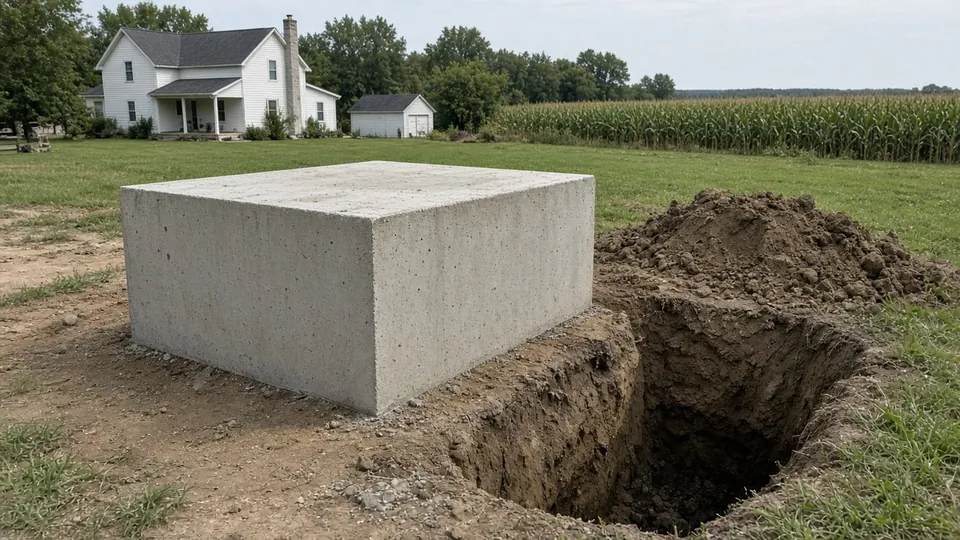
A prefabricated bunker is a factory-built steel or concrete shelter delivered by truck and installed on site, either below ground or anchored above ground. Because it is made off site, installation can be quick, but site preparation and anchoring still decide performance.
Prefabricated units come in set sizes, so choose one that fits everyone in your household with room to sit. FEMA P-320 gives minimum floor area guidance per occupant that is useful when comparing sizes.
Ask for documentation that the model has been tested to ICC 500, and that installation follows the manufacturer's anchoring specifications. Delivery needs truck and crane access, which matters on tight lots or behind fences.
Rural properties across Indiana often have the open space prefabricated units need. Rules differ between cities and counties, so check with your local building department before installation.
Why it matters in Indiana
Indiana averages 22 tornadoes a year, and NWS Indianapolis counted a record 88 in 2026 (through Sept. 10, 2026). Deadly tornadoes have struck Evansville, Kokomo, Henryville and many other communities, so a planned shelter is how many households prepare.
Indiana averages 22 tornadoes a year, and NWS Indianapolis counted a record 88 in 2026 (through Sept. 10, 2026), including 58 in June 2026 alone. The Palm Sunday outbreak of April 11, 1965 killed 137 people in Indiana, and the April 3, 1974 Super Outbreak killed 47. Since 1950 tornadoes have caused 273 deaths and 4,343 injuries in the state (through 2024), according to NWS Indianapolis Indiana tornado statistics. More recently, the Henryville EF4 of March 2, 2012 reached 175 mph and struck a school complex (NWS Louisville: Henryville EF4 survey).
What it costs
No official source publishes a price for this shelter type alone, and this site has no prices of its own. Published FEMA and FLASH ranges for safe rooms are shown below with their sources; installers quote your project after reviewing the property.
FEMA P-320, Taking Shelter from the Storm (5th ed., 2021) (Table II-3) lists average new-construction costs of about $6,300–$8,300 for an 8×8 ft safe room and $11,400–$13,600 for a 14×14 ft room. The FEMA residential safe room fact sheet gives about $8,000–$9,500 and $14,000–$17,000 for the same sizes. FLASH (Federal Alliance for Safe Homes) puts site-built and prefabricated safe rooms at roughly $3,000–$9,500 depending on size. Retrofits usually cost more; these are published ranges, not quotes.
| Cost factor | Why it matters | Price |
|---|---|---|
| Shelter type | Below-ground, garage floor, above-ground, safe room or prefabricated unit; each has different excavation, anchoring and material needs. | Quoted by the installer |
| Size and capacity | FEMA and FLASH ranges rise with floor area; plan for everyone in the household. | Quoted by the installer |
| New construction or retrofit | FEMA notes retrofits in existing homes generally cost more than building a safe room during construction. | Quoted by the installer |
| Site and soil | Excavation, groundwater, slab condition, drainage and access for delivery trucks. | Quoted by the installer |
| Doors, ventilation and testing | Tested door assemblies and ICC 500 documentation. | Quoted by the installer |
| Permits | Indianapolis requires a structural permit for new structures; elsewhere ask your city or county building department. | Quoted by the installer |
| Your project | Estimate request. No verified local prices exist, so this site publishes none of its own. Published FEMA and FLASH ranges are on the cost page. | |
How the process works
You send an estimate request, it is shared with independent local installers, they review your property and give written quotes, and you decide whether to hire anyone. Check permits and ICC 500 testing before you sign. Each step is listed below.
Send an estimate request
Tell us your town or ZIP, the shelter type you are considering and whether it is a new build or an existing home.
Your request goes to Silvano Para
The operator of this site reviews it and, with your consent, shares it with independent local installers serving your area.
Installers contact you
They may ask about your lot, basement, garage slab or floor plan and arrange a visit to look at the location.
You compare written quotes
Ask each installer about ICC 500 testing, permits, anchoring, insurance and what is included.
You decide
You are never obliged to hire anyone. Any contract and payment are between you and the installer.
Where you can request it
Requests are accepted from across Indiana. Twelve areas, from Fort Wayne to Evansville and Jasper, have their own page with local tornado facts and permit notes; installers confirm availability for your address before arranging a visit.
- Storm shelters in Indianapolis
- Storm shelters in Lafayette
- Storm shelters in Evansville
- Storm shelters in Carmel & Fishers
- Storm shelters in Anderson
- Storm shelters in Kokomo
- Storm shelters in Fort Wayne
- Storm shelters in Bloomington
- Storm shelters in Muncie
- Storm shelters in Terre Haute
- Storm shelters in Columbus
- Storm shelters in Vincennes
Other types of storm shelters
The same estimate request covers the other shelter types. If an installer finds another type suits your home better, such as a garage floor unit instead of an in-ground one, they can quote that instead. Compare them all before you decide.
Request Shelter Information
Estimate request. Independent installers set any price after reviewing your property.
Service Areas
Requests are accepted from across Indiana, and twelve areas have their own page with local tornado facts: Indianapolis, Lafayette, Evansville and Jasper, Carmel and Fishers, Anderson, Kokomo, Fort Wayne, Bloomington, Muncie, Terre Haute, Columbus and Vincennes. Installers confirm whether they cover your address.
| Area | County | Population (2020) | NWS warning office |
|---|---|---|---|
| Indianapolis, IN | Marion | 887,642 | NWS Indianapolis |
| Lafayette, IN | Tippecanoe | 70,783 | NWS Indianapolis |
| Evansville, IN | Vanderburgh | 117,298 | NWS Paducah (Evansville) and NWS Louisville (Jasper) |
| Carmel & Fishers, IN | Hamilton | 99,757 / 98,977 | NWS Indianapolis |
| Anderson, IN | Madison | 54,788 | NWS Indianapolis |
| Kokomo, IN | Howard | 59,604 | NWS Indianapolis |
| Fort Wayne, IN | Allen | 263,886 | NWS Northern Indiana |
| Bloomington, IN | Monroe | 79,168 | NWS Indianapolis |
| Muncie, IN | Delaware | 65,194 | NWS Indianapolis |
| Terre Haute, IN | Vigo | 58,389 | NWS Indianapolis |
| Columbus, IN | Bartholomew | 50,474 | NWS Indianapolis |
| Vincennes, IN | Knox | 16,759 | NWS Indianapolis |
Population: 2020 Census via Wikipedia. Coverage outside these areas depends on installer availability.
- Storm shelters in Indianapolis
- Storm shelters in Lafayette
- Storm shelters in Evansville
- Storm shelters in Carmel & Fishers
- Storm shelters in Anderson
- Storm shelters in Kokomo
- Storm shelters in Fort Wayne
- Storm shelters in Bloomington
- Storm shelters in Muncie
- Storm shelters in Terre Haute
- Storm shelters in Columbus
- Storm shelters in Vincennes
- All service areas
Map © OpenStreetMap contributors. The map shows the area only; there is no office or showroom.